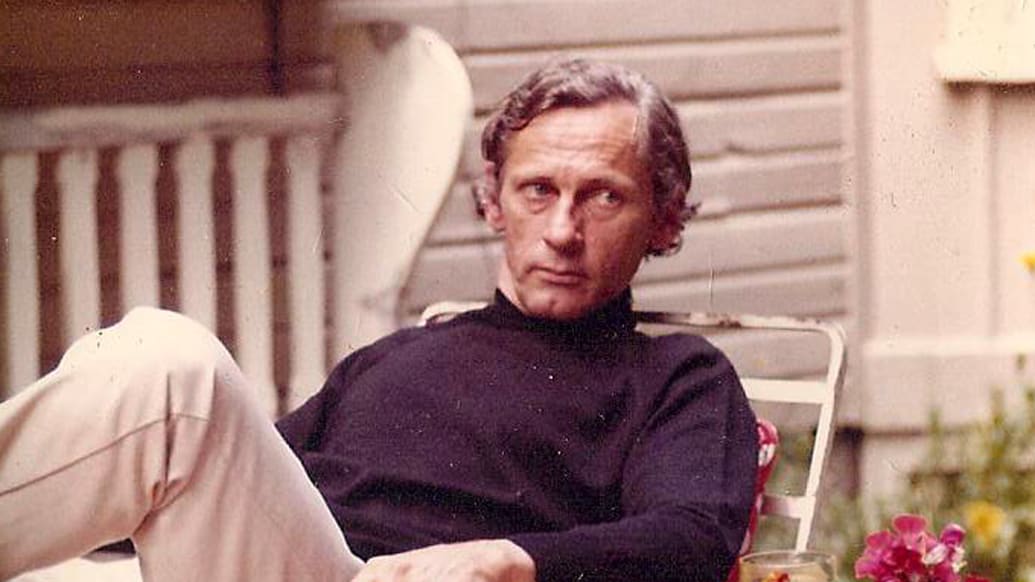
Showing posts with label fiction. Show all posts

Friday, June 28, 2024

Michael Cunningham


Michael Cunningham's picture


from Larry and Bobby Kissing

Were they glad about it? Was Larry glad the night he kissed me back to life? Was I? I’d been among the dead for so long. Sleep, gym, hustle, dinner, hustle, sleep, repeat.

I never kissed any of them. That was the line I drew. That was what kept me in my body, kept me from getting sucked into their vortexes.

Until Larry kissed me. It hadn’t been my idea.

I thought, at first, I wanted to be dead again, to go back to that endless smoky undream, but he kept kissing me, and I kept kissing him, and by now, I don’t think he’d let me go back to being dead, even if I asked him to. By now, I don’t think I’d want to go back.

That’s why I’m in love with him. That’s why I’m gladdened. That’s why I seem to wish, every now and then, when love gets into me like a fishhook and pulls me, gasping, out of myself — when I start to fear everything that might happen if I abandon me and enter him — that he’d disappear, so I could be dead again. 


Saturday, April 13, 2024

David Foster Wallace

  Drawing of the man Himself.

from The Pale King

§2

From Midway Claude Sylvanshine then flew on something called Consolidated Thrust Regional Lines down to Peoria, a terrifying thirty-seater whose pilot had pimples at the back of his neck and

reached back to pull a dingy fabric curtain over the cockpit and the beverage service consisted of a staggering girl underhanding you nuts while you chugged a Pepsi. Sylvanshine’s window seat was in

8-something, an emergency row, beside an older lady with a sacklike chin who could not seem despite strenuous efforts to open her nuts. The core accounting equation A = L + E can be dissolved and reshuffled into everything from E = A – L to beyond. The craft rode the updrafts and downdrafts like a dinghy in a gale. The only service into Peoria was regional out of either St. Louis or the two Chicagos. Sylvanshine had an inner ear thing and couldn’t read on planes but did read the emergency laminated card thing, twice. It was mostly illustrations; for legal reasons, the airline had to presume illiteracy. Without being aware that he was doing so, Sylvanshine mentally repeated the word illiterate several dozen times until the word ceased to mean anything and became just a rhythmic sound, not unlovely but out of sync with the propellors’ flux’s pulse. It was something he did when he was under stress and did not want an incursion. His point of departure was Dulles after a Service shuttle from Shepherdstown/Martinsburg. The three major codifications of US tax law being of course ’16, ’39, and ’54, with ’81 and ’82’s indexing and anti-abuse provisions also relevant. The fact that another major recodification was on the horizon would not, obviously, be on the CPA exam.


David Foster Wallace


David Foster Wallace
from Infinite Jest

‘My application’s not bought,’ I am telling them, calling into the darkness of the red cave that opens out before closed eyes. ‘I am not just a boy who plays tennis. I have an intricate history. Experiences and feelings. I’m complex.’I read,’ I say. ‘I study and read. I bet I’ve read everything you’ve read. Don’t think I haven’t. I consume libraries. I wear out spines and ROM-drives. I do things like get in a taxi and say, “The library, and step on it.” My instincts concerning syntax and mechanics are better than your own, I can tell, with due respect. But it transcends the mechanics. I’m not a machine. I feel and believe. I have opinions. Some of them are interesting. I could, if you’d let me, talk and talk. Let’s talk about anything. I believe the influence of Kierkegaard on Camus is underestimated. I believe Dennis Gabor may very well have been the Antichrist. I believe Hobbes is just Rousseau in a dark mirror. I believe, with Hegel, that transcendence is absorption. I could interface you guys right under the table,’ I say. ‘I’m not just a creatus, manufactured, conditioned, bred for a function.’

I open my eyes. ‘Please don’t think I don’t care.’

On how to present well in an Alcoholics Anonymous session:

The thing is it has to be the truth to really go over, here. It can’t be a calculated crowd-pleaser, and it has to be the truth unslanted, unfortified. And maximally unironic. An ironist in a Boston AA meeting is a witch in church. Irony-free zone. Same with sly disingenuous manipulative pseudo-sincerity. Sincerity with an ulterior motive is something these tough ravaged people know and fear, all of them trained to remember the coyly sincere, ironic, self-presenting fortifications they’d had to construct in order to carry on Out There, under the ceaseless neon bottle.

On what it’s like to be and feel depressed:

It’s the mornings after the spider-and-heights dreams that are the most painful, that it takes sometimes three coffees and two showers and sometimes a run to loosen the grip on his soul’s throat; and these post-dream mornings are even worse if he wakes unalone, if the previous night’s Subject is still there, wanting to twitter, or to cuddle and, like, spoon, asking what exactly is the story with the foggy inverted tumblers on the bathroom floor, commenting on his night-sweats, clattering around in the kitchen, making kippers or bacon or something more hideous and unhoneyed he’s supposed to eat with post-coital male gusto, the ones who have this thing about they call it Feeding My Man, wanting a man who can barely keep down A.M. honey-toast to east with male gusto, elbows out and sovelling, making little noises. Even when alone, unable to uncurl alone and sit slowly up and wing out the sheet and go to the bathroom, these darkest mornings start days that Orin can’t even bring himself for hours to think about how he’ll get through the day. These worst mornings with cold floors and hot windows and merciless light — the soul’s certainty that the day will have to be not traversed but sort of climbed, vertically, and then that going to sleep again at the end of it will be like falling, again, off something tall and sheer.


David Foster Wallace


Baldauf refers to her habit of duplication as “Only Only,” which is drawn from a typo found in Zorn’s translation of “Art in the Age of Mechanical Reproduction,” by Walter Benjamin, an occurrence that Baldauf feels adequately sums up the entire essay.

from Infinite Jest

 That the chilling Hispanic term for whatever interior disorder drives the addict back again and again to the enslaving Substance is tecato gusano, which apparently connotes some kind of interior psychic worm that cannot be sated or killed.

That it is possible, in sleep, for some roommates to secure a cigarette from their bedside pack, light it, smoke it down to the quick, and then extinguish it in their bedside ashtray—without once waking up, and without setting anything on fire. You will be informed that this skill is usually acquired in penal institutions, which will lower your inclination to complain about the practice. Or that even Flent’s industrial-strength expandable-foam earplugs do not solve the problem of a snoring roommate if the roommate in question is so huge and so adenoidal that the snores in question also produce subsonic vibrations that arpeggio up and down your body and make your bunk jiggle like a motel bed you’ve put a quarter in.

That females are capable of being just as vulgar about sexual and eliminatory functions as males. That over 60% of all persons arrested for drug and alcohol-related offenses report being sexually abused as children, with two-thirds of the remaining 40% reporting that they cannot remember their childhoods in sufficient enough detail to report one way or the other on abuse. That you can weave hypnotic Madame Psychosis-like harmonies around the minor-D scream of a cheap vacuum cleaner, humming to yourself as you vacuum, if that’s your Chore. That some people really do look like rodents. That some drug-addicted prostitutes have a harder time giving up prostitution that they have giving up drugs, with their explanation involving the two habits’ very different directions of currency-flow. That there are just as many idioms for the female sex-organ as there are for the male sex-organ.

That the little-mentioned paradox of Substance addiction is: that once you are sufficiently enslaved by a Substance to need to quit the Substance in order to save your life, the enslaving Substance has become so deeply important to you that you will all but lose your mind when it is taken away from you. Or that sometime after your Substance of choice has just been taken away from you in order to save your life, as you hunker down for the required AM and PM prayers, you will find yourself beginning to pray to be allowed to literally lose your mind, to be able to wrap up your mind in an old newspaper or something and leave it in an alley to shift for itself, without you.

That in metro Boston the idiom of choice for the male sex-organ is: Unit, which is why Ennet House residents are wryly amused by E.M.P.H. Hospital’s designations of its campus’s buildings.

That certain persons simply will not like you no matter what you do. Then that most non addicted adult civilians have already absorbed and accepted this fact, often rather early on.

That no matter how smart you thought you were, you are actually way less smart than that.

That AA and NA and CA’s ‘God’ does not apparently require that you believe in Him/Her/It before He/She/It will help you.(59) That, pace macho bullshit, public male weeping is not only plenty masculine but can actually feel good(reportedly). That sharing means talking, and taking somebody’s inventory means criticizing that person, plus many additional pieces of Recoveryspeak. That an important part of the halfway-house Human Immuno-Virus prevention is not leaving your razor or toothbrush in communal bathrooms. That apparently a seasoned prostitute can (reportedly) apply a condom to a customer’s Unit so deftly he doesn’t even know it’s on until he’s history, so to speak.


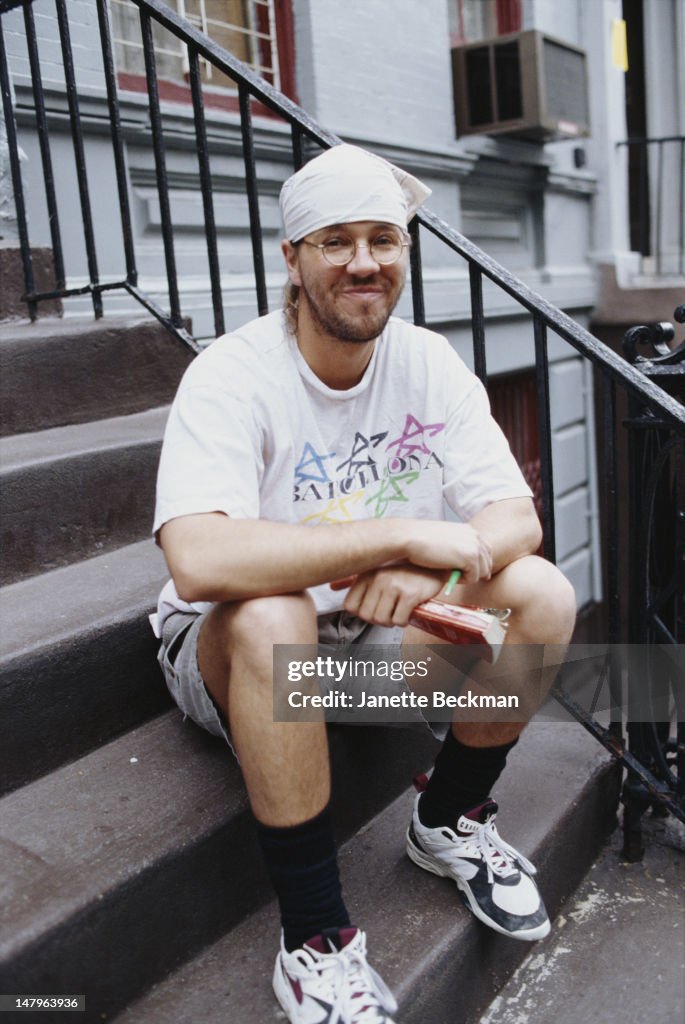
Sunday, March 17, 2024

Zaidie Smith


from White Teeth

Archie dragged his head off the steering wheel. And in the moment between focusing on the sweaty bulk of a brown-skinned Elvis and realizing that life was still his, he had a kind of epiphany. It occurred to him that, for the first time since his birth, Life had said Yes to Archie Jones. Not simply an 'OK' or 'You-might-as-well-carry-on-since-you've-started', but a resounding affirmative. Life wanted Archie. She had jealously grabbed him from the jaws of death, back to her bosom. Although he was not one of her better specimens, Life wanted Archie and Archie, much to his own surprise, wanted Life. 


Wednesday, January 31, 2024

Richard Powers


“Social developments often collect such a massy inertia that years pass before a tendency shows its results. The private automobile provides a good illustration. Ford perfected the under-five-hundred-dollar automobile in the first decade of the century, but it took another seventy years for this country to find itself hostage to oil-rich nations, increasingly susceptible to respiratory and oncological diseases, unable to get from A to B except through private ownership, and every fifteen years acquiring enough highway fatalities to level the city of Houston.” 
********
“...legend crystallized her life (Sarah Bernhardt) until she became her observers' rumors. At the end, we all become edited copy".” 
                               -----Richard Powers, Three Farmers on Their Way to a Dance

Richard Powers

 “We found that trees could communicate, over the air and through their roots. Common sense hooted us down. We found that trees take care of each other. Collective science dismissed the idea. Outsiders discovered how seeds remember the seasons of their childhood and set buds accordingly. Outsiders discovered that trees sense the presence of other nearby life. That a tree learns to save water. That trees feed their young and synchronize their masts and bank resources and warn kin and send out signals to wasps to come and save them from attacks. “Here’s a little outsider information, and you can wait for it to be confirmed. A forest knows things. They wire themselves up underground. There are brains down there, ones our own brains aren’t shaped to see. Root plasticity, solving problems and making decisions. Fungal synapses. What else do you want to call it? Link enough trees together, and a forest grows aware.” 

― Richard Powers, The Overstory

Friday, November 10, 2023

Kazuo Ishiguro


from Never Let Me Go


"It was like when you make a move in chess and just as you take your finger off the piece, you see the mistake you've made, and there's this panic because you don't know yet the scale of disaster you've left yourself open to.” 

*****

“I keep thinking about this river somewhere, with the water moving really fast. And these two people in the water, trying to hold onto each other, holding on as hard as they can, but in the end it’s just too much. The current’s too strong. They’ve got to let go, drift apart.” 

*****

“As I’ve said, it wasn’t until a long time afterwards—long after I’d left the Cottages—that I realized just how significant out little encounter in the churchyard had been. I was upset at the time, yes. But I didn’t believe it to be anything so different from other tiffs we’d had. It never occurred to me that our lives, until then so closely interwoven could unravel and separate over a thing like that.
But the fact was, I suppose, there were powerful tides tugging us apart by then, and it only needed something like that to finish the task. If we’d understood that back then—who knows?—maybe we’d have kept a tighter hold of one another.” 

Friday, November 3, 2023

Kazuo Ishiguro

Kazuo Ishiguro


“Your wound, your silly little wound! That's your real love, Leo, that wound, the one true love of your life! I know how it will be, even if we tried, even if we managed to build something all over again. The music too, that would be no different. Even if they'd accepted you tonight, even if you became celebrated in this town, you'd destroy it all, you'd destroy everything, pull it all down around you just as you did before. And all because of that wound. Me, the music, we're neither of us anything more to you than mistresses

you seek consolation from. You'll always go back to your one real love. To that wound! And you know what makes me so angry? Leo, are you listening to me? Your wound, it's nothing special, nothing special at all. In this town alone, I know there are many people with far worse. And yet they carry on, every one of them, with far greater courage than you ever did. They go on with their lives. They become something worthwhile. But you, Leo, look at you. Always tending your wound.” 
                                                                                                                                The Unconsoled

Monday, September 25, 2023

Jonathan Franzen


Excerpt from Freedom:

In the earliest years, when you could still drive a Volvo 240 without feeling self-conscious, the collective task in Ramsey Hill was to relearn certain life skills that your own parents had fled to the suburbs specifically to unlearn, like how to interest the local cops in actually doing their job, and how to protect a bike from a highly motivated thief, and when to bother rousting a drunk from your lawn furniture, and how to encourage feral cats to shit in somebody else’s children’s sandbox, and how to determine whether a public school sucked too much to bother trying to fix it. There were also more contemporary questions, like, what about those cloth diapers? Worth the bother? And was it true that you could still get milk delivered in glass bottles? Were the Boy Scouts OK politically? Was bulgur really necessary? Where to recycle batteries? How to respond when a poor person of color accused you of destroying her neighborhood? Was it true that the glaze of old Fiestaware contained dangerous amounts of lead? How elaborate did a kitchen water filter actually need to be? Did your 240 sometimes not go into overdrive when you pushed the overdrive button? Was it better to offer panhandlers food, or nothing? Was it possible to raise unprecedentedly confident, happy, brilliant kids while working full-time? Could coffee beans be ground the night before you used them, or did this have to be done in the morning? Had anybody in the history of St. Paul ever had a positive experience with a roofer? What about a good Volvo mechanic? Did your 240 have that problem with the sticky parking-brake cable? And that enigmatically labeled dashboard switch that made such a satisfying Swedish click but seemed not to be connected to anything: what was that?

Tuesday, May 2, 2023

Ben Lerner

Ben Lerner

Ben Lerner

Three prose poems

from «Angle Of Yaw»


THE DARK CROWD CANNOT BE SEEN DIRECTLY, the dark crowd does not interact with light, but the dark crowd can be detected by measuring its gravitational effects on visible crowds. The visible crowd moves toward the dark crowd, as insects toward a black light trap, in the tropism we call history. Riot guns with rubber bullets, tear gas, water canons, flying wedges of heavily armored police, are not only incapable of dispersing the dark crowd, but, by inciting a phase change in the visible crowd, expand its ranks.


WE ARE PLEASED TO OFFER A LAMP that turns on and off when you clap, when you clap your eyes. A lamp that lets you see in the dark without disturbing the dark. A lamp producing natural light. A lamp that when you clap turns on and on.


THE SOLDIER IN THE FILM asks the audience to describe his wounds. Unaware his legs are elsewhere, he attempts to walk out of the screen. What matters is the form, not the content, of the airdrop, how it alludes to Manna. Then kill me, he begs. Active soldiers act like actors, inactive actors act like soldiers, audience members vomit in their giant sodas. Dance, I say, aiming near his feet. Think, I say, aiming near his head. The crowd dismembers. Now I’m on my back, making an angel, awaiting, not the peanut butter and propaganda, but the flowering apparatus that retards its fall.


Sunday, April 16, 2023

Don Dellilo

first lines of Players

"Someone says: 'Motels. I like motels. I wish I owned a chain, worldwide. I'd like to go from one to another to another, There's something self-realizing about that.'"


Don Dellilo

from the story "Sine cosine tangent" Zero K

I was afraid of other people’s houses. After school, sometimes a friend might talk me into going to his house or apartment to do our homework together. It was a shock, the way people lived, other people, those who weren’t me. I didn’t know how to respond to the clinging intimacy of it, kitchen slop, pan handles sticking out of the sink. Did I want to be curious, amused, indifferent, superior? Just walking past a bathroom, a woman’s stocking draped over the towel rack, pill bottles on the windowsill, some open, some capsized, a child’s slipper in the bathtub—it made me want to run and hide, partly from my own fastidiousness. The bedrooms with unmade beds, somebody’s socks on the floor, the old woman in nightclothes, barefoot, an entire life gathered up in a chair by the bed, hunched frame and muttering face. Who were these people, minute to minute and year after year? It made me want to go home and stay there.

**********

The smell of other people’s houses. There was the kid who posed for me in his mother’s hat and gloves, although it could have been worse. The kid who said that he and his sister had to take turns swabbing lotion on their father’s toenails to control some hideous creeping fungus. He thought this was funny. Why didn’t I laugh? He kept repeating the word “fungus” while we sat at the kitchen table to do our homework together. A half slice of withered toast slumped in a saucer still damp with spilled coffee. Sine cosine tangent. Fungus fungus fungus.


Don Dellilo

Mao II

from Mao II

 “The only private language I know is self-exaggeration. I think I've grown a second self in this room. It's the self-important fool that keeps the writer going. I exaggerate the pain of writing, the pain of solitude, the failure, the rage, the confusion, the helplessness, the fear, the humiliation. The narrower the boundaries of my life, the more I exaggerate myself. If the pain is real, why do I inflate it? Maybe this is the only pleasure I'm allowed.” 

*******

“He looked at a picture on the wall and saw everything that existed outside the room he was sitting in and the one he was trying to write about. It was a picture of fishing nets stowed in canvas baskets and it had sex, memories, cravings, names of old friends, principal rivers of the world. Writing was bad for the soul when you got right down to it. It protected your worst tendencies. Narrowed everything to failure and its devastations. Gave your cunning an edge of treachery and your jellyfish heart a reason to fall deeper into silence.” 

**********

“News of disaster is the only narrative people need. The darker the news, the grander the narrative. News is the last addiction before—what? I don't know. But you're smart to trap us in your camera before we disappear.” 

**********

“I don’t like not believing. I’m not at peace with it. I take comfort when others believe.” “Karen thinks God is here. Like walkin’ and talkin’.” “I want others to believe, you see. Many believers everywhere. I feel the enormous importance of this. When I was in Catania and saw hundreds of running men pulling a saint on a float through the streets, absolutely running. When I saw people crawl for miles on their knees in Mexico City on the Day of the Virgin, leaving blood on the basilica steps and then joining the crowd inside, the crush, so many people that there was no air. Always blood. The Day of Blood in Teheran. I need these people to believe for me. I cling to believers. Many, everywhere. Without them, the planet goes cold.” 

Saturday, April 15, 2023

Don Dellilo

Picture

from White Noise

 A woman fell into a rack of paperback books at the front of the store. A heavyset man emerged from the raised cubicle in the far corner and moved warily toward her, head tilted to get a clearer sightline. A checkout girl said, “Leon, parsley,” and he answered as he approached the fallen woman, “Seventy-nine.” His breast pocket was crammed with felt-tip pens.

“So then you cook at the rooming house,” Babette said.

“My room is zoned for a hot plate. I’m happy there. I read the TV listings, I read the ads in Ufologist Today. I want to immerse myself in American magic and dread. My seminar is going well. The students are bright and responsive. They ask questions and I answer them. They jot down notes as I speak. It’s quite a surprise in my life.”

He picked up our bottle of extra-strength pain reliever and sniffed along the rim of the child-proof cap. He smelled our honeydew melons, our bottles of club soda and ginger ale. Babette went down the frozen food aisle, an area my doctor had advised me to stay out of.

“Your wife’s hair is a living wonder,” Murray said, looking closely into my face as if to communicate a deepening respect for me based on this new information.

**********

“The family is the cradle of the world’s misinformation. There must be something in family life that generates factual error. Over-closeness, the noise and heat of being. Perhaps even something deeper like the need to survive. Murray says we are fragile creatures surrounded by a world of hostile facts. Facts threaten our happiness and security. The deeper we delve into things, the looser our structure may seem to become. The family process works towards sealing off the world. Small errors grow heads, fictions proliferate. I tell Murray that ignorance and confusion can’t possibly be the driving forces behind family solidarity. What an idea, what a subversion. He asks me why the strongest family units exist in the least developed societies. Not to know is a weapon of survival, he says. Magic and superstition become entrenched as the powerful orthodoxy of the clan. The family is strongest where objective reality is most likely to be misinterpreted. What a heartless theory, I say. But Murray insists it’s true.” 
― Don DeLillo, White Noise

Don Dellilo


slightly older men and women, they had professions and soft slacks with knife pleats and a certain ease of bearing and belonging, the package of attitudes and values known as lifestyle” 

― Don DeLillo, Underworld


“Cotter thinks he sees a path to the turnstile on the right. He drains
himself of everything he does not need to make the jump. Some are still 
jumping, some are thinking about it, some need a haircut, some have girlfriends in woolly sweaters and the rest have landed in the ruck and are 
trying to get up and scatter. A couple of stadium cops are rumbling down the
ramp. Cotter sheds these elements as they appear, sheds a thousand waves of information hitting on his skin. His gaze is trained on the iron bars
projected from the post. He picks up speed and seems to lose his 
gangliness, the slouchy funk of hormones and unbelonging and all the
stammering things that seal his adolescence. He is just a running boy, a
half-seen figure from the streets, but the way running reveals some clue to 
being, the way a runner bares himself to consciousness, this is how the
dark-skinned kid seems to open to the world, how the bloodrush of a dozen 
strides brings him into eloquence.” 
― Don DeLillo, Underworld

mIEKAL aND

  Misha Sprocket,  do.not.hold.these.words.as.dear Limbs extending outward from. These eyes are your eyes, not mine? Subliminal does not sub...