I think I should go in and see her. Can I stand it. She is shaking. No doubt. I should go in. She’ll be pouring another glass. It stops the shaking. No doubt. She’ll be sitting in front of that stupid painting she likes, she’ll talk about going out to shovel the steps before it freezes, maybe she will go out, slip on the steps and kill herself, that will stop the shaking, no doubt! I should go in. I go in. I say, You are the worst thing I know I can’t breathe around you the world is more than this I am more than you put on your black coat we’re going out. We go out. We ride through the birch trees. I should tie her hands to my coat, I think, her behind me, and so I do or she would fall. We ride and yell and ride and yell and that’s the best of us anymore, that’s all we can get to anymore.
I do not intend to hurt anyone. I did not intend to hurt anyone. O Jerusalem, we gutless few delighting sobre tierra de libres In perspicacity what you would see if you were not drown’d in sound and sight wooly-headed as a chrysanthemum literal as the lamb. What we could do as one in two, our prayers made hand-in-hand you are my voodoo chile my voodoo chile
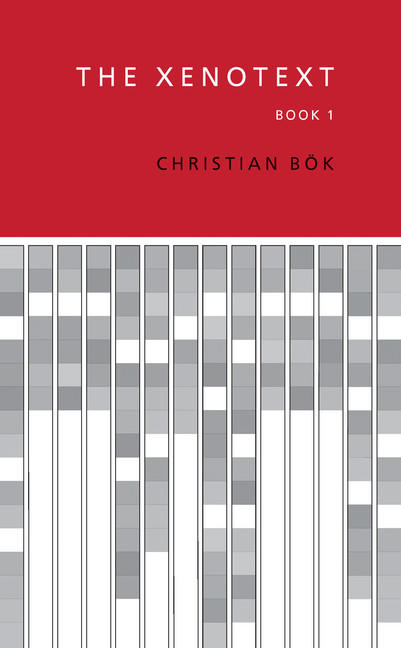
Enciphered in a bacterium, The Xenotext is the world’s first living poem. Christian Bök has spent more than 10 years writing what promises to be the first example of ‘”living poetry.” After successfully demonstrating his concept in a colony of E. coli, Bök is on the verge of enciphering a beautiful, anomalous poem into the genome of an unkillable bacterium (Deinococcus radiodurans), which can, in turn, ‘read’ his text, responding to it by manufacturing a viable, benign protein, whose sequence of amino acids enciphers yet another poem. The engineered organism might conceivably serve as a post-apocalyptic archive, capable of outlasting our civilization.
a samizdat of madness ad nauseum naziism is a zaibatsu of bizness ad hominem
zaum noise my monsoon i immunize its asthma merz rhyme my rhizome i memorize its enzyme mars muzak comet zoom cosmonauts own zurich marx mecca comma moon communists ski munich
a maverick mass of us my samovar of vacuums a volatile love of it my molotov of volumes
no vertigo like vodka the improv of gravity no volapuk like opera the pravda of poverty
make codes my czarina commissars of stardom burn books by oktober troubadors of boredom
Listening to Tom Jones on LP and reading Carlyle? Why didn’t I say emotion? Why didn’t I say documents? I used the language of a baroque politics. That was a real lie.
Waking up in cabins in 1979 Is the polder of happiness like that? the long slash of pure gold opening up behind the utility shed shabby and powerless the low lichen the deep fog – How does it work?
That other time we called our theory Toxins we became adepts of its excellence we thought our city would be a place but it is a leak and I will feel shame mortal shame that I am not a tree. How can I make time out of toxins?
in history there is always someone and there is what someone has made: a polder of half-scale kitchen chairs and used file folders and research as pleasure. This slight revolt distributes itself froth-like over the social surface, and it is large enough to hold everything. It is the liberation of matter. What does that look like? I want to know too, but I think it’s not optical.
I dream of escaping running into the cornfield. Inside the cornfield I find tiny battered civilizations. They give me something to do.
Who am I? – if not some neglected astronaut, being immolated by a fierce aurora, while striding in my spacesuit across the Avenue of the Americas. Who am I? – if not some phan- tom, fighter pilot, dreaming that, while weightless during free fall through a vacuum, my glass visor shatters at the sight of a turtledove. Who am I? – if not some poltergeist, imprisoned in a ruby room, aboard a ship, now derelict in the shoals, offshore from a swelling fireball. Yes, I have a soul (like you) – but mine is made of little robots. And no one sings me lullabies. And no one makes me close my eyes. And so I throw the windows wide, to call to you across the skies. And yet, I know that nowhere, among these glow- ing nebulae, do any of you exist. Who am I? – if not some stowaway in a microbe or some castaway in a seedlet. And yet, I must let loose upon the world my perfect malware. It is like the voice of a child, saying goodbye in the dark.
Wershler-Henry suggests that, because we are faced with the impossibility of composing something totally innovative, we may have little choice but to pick through the rubble of the past, jerryrigging contraptions that that fuse old parts with new ideas, coalescing them syncretically into a contradictory set of unpredictable regenerations (like an unholy hybrid, for example, of Langpo spliced, say, with Vispo, Oulipo, and Fluxus). Future advances in the aesthetic formalism of poetry seem unlikely to occur unless we can experiment more audaciously with the technical apparatus of the book, disrupting the sequential temporality and stratified pagination of such a medium in order to produce the kind of text that might easily be mistaken for an interactive sculpture, a mechanized appliance, or even an artificial ecosystem. We may exalt the poets of the future, not because they can write great poems, but because they can program devices that can write great poems for us, doing so automatically within a digital economy of unrestricted expenditure. We may also want to keep in mind too that we are probably the first generation of poets who can reasonably expect to write poetry for inhuman readers, be they aliens, robots, or clones. The new millenium brings with it the prospect of poetry becoming a weird genre of science-fiction, fusing aesthetic concepts with technical conceits in order to foster our own pataphysical speculations.
Oh, and while I haven’t yet taken to walking backwards, I am sleeping backwards and I might also be thinking backwards.
But look, I mean who is going to complain about having two manuscripts when you were only planning on one? Sort of like having twins when you were only thinking of one, which sounds familiar and stressful.
I’m working on a poetry manuscript that seems to have split into two manuscripts. More confusing, I’m writing it backwards. I start at the beginning each time I sit down, and write the page prior to that.
So, when you asked me this originally what I was working on a big sigh went up. Apparently I am working on telling Jonathan what I am working on.
The new LemonHound.com is due to be unveiled. That has taken up more time than expected even though there are some dozen writers involved. It will be amazing. More than I thought it could be.
I am not teaching this fall so I am supposed to ONLY be working on MY OWN POETRY, but this proves very difficult with 1 year old twins, and students, even if I am not teaching them, and the ongoing world of my Internet life.
Somebody left the world last night, and last, and last, and last: wild is the glower of wind, and words too thin, too meek to shelter. Lament in rhyme, she says, lament in roses: he was, and is not! It will always be darker soon, colder, you who are part anger who bent down in winter, know that your prayers cannot dismiss the darting shade. No, let us not shit upon the ground near the lone pile with ivy overspread, and let me not your giddiness flatten, for so fine the season, so serene the hour and all I have left of that moment is this torn scrap.
I weave my bones thru the freeway haze at Rincon, the self returns again, my natal self: what you see is the red-shouldered judge of the Quirky and Dead. I am not man, man is death, and the world pain.We were all uncountable stars then: the tilt of earth is beautiful from every angle.
I mourn for Adonis—I expected her to look more dead in the casket. Let them bury your big eyes death, be not loud; your hand did not give her this blow, she was borne to church on glasses of Grey Goose: Only the bottle knows she is gone. Damn the snow,an uneven basin to stroll: the curfew tolls the knell of closing time. The moon still sends its abundant light. It is a hard time among these stones, for all the toppled, liquid graves. A slumber did your spirit steal. At Wilshire & Santa Monica an opossum crossed. I thought, two forms move among the dead, high sleep, so prescient your absence.
Small is the poet’s needle, God knows: but inside the heart a broken night advances in its glass. Death knelt among thestarving children on your plate: I sometimes think of those pale, perfect faces who die as cattle, and I can not sleep.
The city you graced was swift. Now that the Summer of Love has become the milk of tunnels; now that the chestnut candles burn, so may the trees extend their spreading, there is blessing in this gentle breeze. What need of bells to mark our loss? Shall I go force an elegy? The dead sing Turn the lights down sweetly. No more for us the little sighing, nor the grand. All the new thinking is still about loss.
You are being asked to drop your worm’s eye view Of the world. Signs come at you from every direction: The world is all fists up and fuck it, rivers lift their skirts, Forests whistle for their lost canopies, California Is parched, the celluloid is not soluble. I thought I saw The future on social media, but, no, the future is still In the body. I am humbled by the young ones: I see their Raised glasses clinking in the sunset. I see myself an old spider On crutches, only two of my eight legs function, I move Through the city a ball of pain on stilts tilting into The future, which is bristling and full of fear; but beyond That fear is open space: I think, I must get there, I must Grow arms, more arms, a forest of arms, there are so many Bodies that need holding, there are so many voices to hear.
from an interview in Jacket2 (April 20, 2005)at Studio 111 at the University of Pennsylvania.
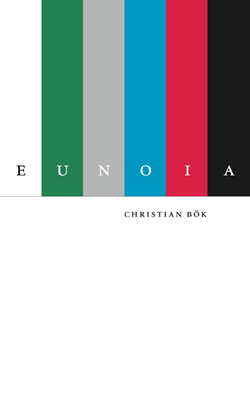
Bök:The wordeunoiais spelled E-U-N-O-I-A. It’s the shortest word in English to contain all the vowels, and it means quite literally, “beautiful thinking.” It’s probably my favorite word in the language. When I first encountered this word, I thought that it would be a great title for a book.
In order to write Eunoia, I had to write five different stories: five narratives, each of which uses only one vowel. In the first chapter, only the letter A appears; in the second chapter, only the letter E appears, etc.
I did this work by first reading the Third Webster’s New International Dictionary, a three-volume dictionary. I read it five times. It has over one and a half million entries, so I had to look at about seven and a half million words in the course of accumulating the requisite vocabulary. I then sorted all the words into topical categories by hand. I didn’t use a computer to do the searching or the sorting, because I thought that it would take about as long to learn the software necessary to do such a task as it would take to actually do it by hand, and I wanted to get started. So I just simply threw myself into the task. I thought that getting the vocabulary was going to be the most arduous part of the work — sorting it into parts of speech, figuring out what the topical categories might be amongst those words, all in an effort to determine what could be said with them. Then I proceeded to arrange them, like a jigsaw puzzle, into something that would be intelligible and that would have a kind of artful, poetic value.
It turned out that the actual search for the words themselves was the easiest part of the work. The remaining seven years required to produce the book involved a tremendous amount of labor and a kind of stubborn commitment, all under very disappointing and desperate conditions.
If the book reveals anything about me personally, I think that it reveals something about my stubborn mindedness — or my obsessive-compulsive disorders.
Bök: When I was working on the book, I noticed lots of spooky moments in my activity. There’s a great deal of paranoia in Eunoia. I began to think that the vowels were, in some way, conspiring amongst themselves to speak on their own behalf. Whenever there were these kind of synchronistic coincidences, where words would fall into place and suddenly say something that seemed very uncanny, if not sublime, then I knew that the work was going well.
But such events occurred with sufficient infrequency that, most of the time, I was in a state of really black desperation. Nevertheless, these little moments of euphoria would occur. These little moments of spookiness would occur with just enough regularity that I would actually feel reinspired to continue the labor necessary to complete the work. When I was finished, I felt a kind of breathless elation at having completed such a lengthy project. Suddenly I realized that my faith in the actual language itself, its ability to work under these extremely adverse conditions, was well warranted. Language is extremely flexible and, in a certain sense, it can’t be censored. I felt a great deal of optimism about this fact when I finished the book.
Bök:The wordeunoiais spelled E-U-N-O-I-A. It’s the shortest word in English to contain all the vowels, and it means quite literally, “beautiful thinking.” It’s probably my favorite word in the language. When I first encountered this word, I thought that it would be a great title for a book.
In order to write Eunoia, I had to write five different stories: five narratives, each of which uses only one vowel. In the first chapter, only the letter A appears; in the second chapter, only the letter E appears, etc.
I did this work by first reading the Third Webster’s New International Dictionary, a three-volume dictionary. I read it five times. It has over one and a half million entries, so I had to look at about seven and a half million words in the course of accumulating the requisite vocabulary. I then sorted all the words into topical categories by hand. I didn’t use a computer to do the searching or the sorting, because I thought that it would take about as long to learn the software necessary to do such a task as it would take to actually do it by hand, and I wanted to get started. So I just simply threw myself into the task. I thought that getting the vocabulary was going to be the most arduous part of the work — sorting it into parts of speech, figuring out what the topical categories might be amongst those words, all in an effort to determine what could be said with them. Then I proceeded to arrange them, like a jigsaw puzzle, into something that would be intelligible and that would have a kind of artful, poetic value.
It turned out that the actual search for the words themselves was the easiest part of the work. The remaining seven years required to produce the book involved a tremendous amount of labor and a kind of stubborn commitment, all under very disappointing and desperate conditions.
If the book reveals anything about me personally, I think that it reveals something about my stubborn mindedness — or my obsessive-compulsive disorders.
Bök: When I was working on the book, I noticed lots of spooky moments in my activity. There’s a great deal of paranoia in Eunoia. I began to think that the vowels were, in some way, conspiring amongst themselves to speak on their own behalf. Whenever there were these kind of synchronistic coincidences, where words would fall into place and suddenly say something that seemed very uncanny, if not sublime, then I knew that the work was going well.
But such events occurred with sufficient infrequency that, most of the time, I was in a state of really black desperation. Nevertheless, these little moments of euphoria would occur. These little moments of spookiness would occur with just enough regularity that I would actually feel reinspired to continue the labor necessary to complete the work. When I was finished, I felt a kind of breathless elation at having completed such a lengthy project. Suddenly I realized that my faith in the actual language itself, its ability to work under these extremely adverse conditions, was well warranted. Language is extremely flexible and, in a certain sense, it can’t be censored. I felt a great deal of optimism about this fact when I finished the book.
Bök: I have no problem with such poetic forms. My only complaint about them is that they do not feel much incentive to innovate, to produce something new in order to reinvent themselves in a manner which is exciting and stimulating. To me, it’s not so important that poetic works actually demonstrate some sort of formalistic character, so long as they have some kind of innovative rationale for their practice. I’m not making a case for a return to a rigorous formality. I’m not that fascistic or schoolmarmish in my sensibilities. I did this project, thinking that it was a kind of experimental work. I didn’t know if it could be done, and I merely conducted the experiment to see what would happen. To me, that’s what writing poetry is about. It’s a kind of heuristic activity, where you indulge in a completely exploratory adventure through language itself.
Bök: In Eunoia, the five chapters have a thematic thread, which runs throughout the entire book. Every chapter must allude to the art of writing. All the chapters have to describe a culinary banquet, a prurient debauch, a pastoral tableaux, and a nautical voyage. These four scenarios are indicative of a vocabulary common to all the five vowels. It’s possible, for example, to say something erotic or culinary in theme throughout all the vowels, because they actually have this vocabulary in common. I wanted there to be a sort of thematic consistency across the entire book. I didn’t want it to be just five separate, individual stories that had no correlations with each other. I wanted there to be some sort of thematic parallelism — and it just so happened that these were the lexicons that were common to the five vowels. So, I included them in the story.
Coincidentally, those four scenarios are also the kinds of scenarios that you typically see in Greek epic poetry. For me, the word eunoia, which is originally from Greek, means quite literally goodwill— it was a term coined by Aristotle to describe the frame of mind that you have to be in, in order to make a friend. It reflects a kind of neoclassical set of values about beautiful thinking. Certainly, there is a kind of classical story in Eunoia. The retelling of the Iliad in chapter E, for example, alludes to these four scenarios, which are common to a classical form of storytelling. You would find these scenes in such an epic.
Bök: If you’re suggesting that I’ve demonstrated that it’s possible for a person to be an avant-garde poet and actually mean something, then right, I agree. When indulging in this kind of formalism, I could say yes — what seems true about any combination of words, according to any series of formal rationales, is that what we call meaning is really a side effect of a particular kind of activity. No matter what combination of words that I might use, no matter how they are arranged or disposed, no matter what kind of formalities are brought to bear upon them, you’re going to find some sort of way to make those associations mean something to you. It seems to me that meaning is always the side effect of such an activity.
T. S. Eliot used to say that meaning was the meat that the burglar threw to the dog. You had to put some meaning in the poem so that something else could take place. You had to satisfy those readers who were begging for some sort of rationale, some sort of purpose for this activity, which, in many respects, is done for its own sake — as a kind of hedonistic enjoyment of language, language free from the need to mean. It takes a little holiday. That’s what’s going on in Eunoia: language has taken a little holiday from the dictionary. I’ve merely shown some sort of incipient, possible combinations and permutations of the words, all of which are actually imminent within the dictionary, within the language itself, but which have been somewhat occluded or eclipsed by other activities in language. That’s what many poets are trying to do nowadays. Certainly, the Language poets do that as well. They’re attempting to show various aspects of ideology in meaningful production, aspects occluded by standard, normative uses of the language.
Airborne honeydew sweetens my spirit with a perfume that, by divine decree, hath enticed me to perform these sonnets for thee, my mæstro, Gaius Mæcenas. Study, with grimness, the plight of puny gods – warlords in a daylong dynasty, whose sieges and jihads I must belaud in song. Scant be my labour, but not my reward, if Apollo favours these rhymes. Annex first to the hive, a haven, blind to winds that hinder foragers in flight, then suffer neither yak nor ewe to trek across these meadows, nor oxen to dash away the dew from phloxes and grasses.






:format(jpeg)/cloudfront-us-east-1.images.arcpublishing.com/tgam/XSRSMY6XUJF33MGKEUMX3APAH4)

 Bök:
Bök: